

When we look at human suffering, we often see a personal story on the surface and a wider pattern underneath. A person says, “I always end up carrying everyone.” Another says, “I disappear when conflict starts.” In our experience, these are not random habits. They often reflect deeper symbolic positions that repeat across family, work, and social life.
In Marquesian systemic constellations, archetypes help us read those positions with more clarity. They do not reduce a person to a label. They reveal the emotional role a person may be living, resisting, or projecting. This changes the quality of the constellation, because what looked like a simple conflict starts to show structure, memory, and meaning.
Archetypes are recurring human patterns that shape how we feel, relate, choose, and interpret reality.
We think this matters because many people arrive at systemic work confused by symptoms. They speak about anxiety, distance, guilt, anger, or fatigue. Yet the visible issue is often only the entrance. Behind it, there may be the wounded child, the rigid judge, the silent exile, the rescuer, or the one who carries a debt that was never truly theirs.
How archetypes appear in constellations
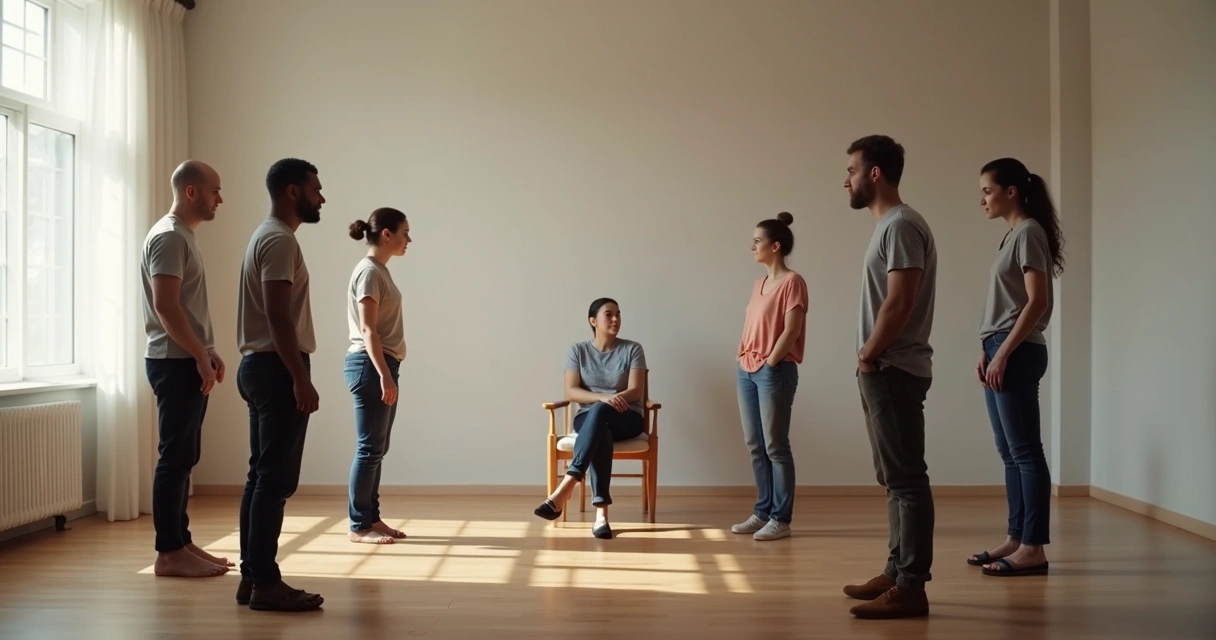
In a constellation, archetypes rarely appear as abstract ideas. They emerge through movements, emotional reactions, body tension, speech, and position in the field. Someone chosen to represent a father may stand far away, unable to look at others. A representative for a daughter may kneel, as if carrying a weight that does not belong to her generation. The scene speaks before any theory does.
We have seen this many times. A person begins by talking about work stress. During the constellation, the pattern shifts into a role of permanent over-responsibility. Soon the image is no longer only about work. It points to an old inner identity: “I survive by holding everything together.” That identity is archetypal in nature. It repeats because it offers belonging, protection, or moral worth.
In systemic constellations, archetypes become visible through relational positions, not just through concepts.
This experiential side has been discussed in research on the integration of psychodrama and systemic constellations, which describes how transgenerational themes and archetypal patterns can emerge in embodied group work. We find this useful because it supports a careful view: symbols are not decoration in systemic work. They can organize experience.
Patterns speak through posture.
Why archetypes help the reading of the field
Without an archetypal lens, a constellation may stay limited to biography. Biography matters, of course. Still, people do not suffer only from events. They also suffer from the roles they built to survive those events. Archetypes help us identify those roles in a way that is both symbolic and practical.
In our reading, archetypes help in at least three ways.
They give language to repeated emotional positions.
They show how personal pain connects to larger family or collective patterns.
They help separate identity from function, so the person can stop confusing “who I am” with “what I learned to do.”
This makes a real difference. A person who always rescues others may believe they are generous by nature. In the constellation, the rescuer archetype may reveal hidden fear, loyalty, and ungrieved loss. Once seen, the movement changes. The person can keep care without keeping self-erasure.
That is why this theme also connects well with reflections on emotional maturity. Maturity grows when we can recognize the role we have been acting and choose a more conscious position.
Common archetypal patterns in systemic work
Not every constellation will show the same figures, and we should avoid forcing interpretation. Still, some patterns appear often enough to deserve attention. We usually observe them as tendencies, not fixed categories.
Some of the most frequent are these:
The rescuer, who gains belonging by carrying what others avoid.
The orphan, who expects abandonment and struggles to trust support.
The judge, who protects order through rigidity, blame, or emotional distance.
The exile, who feels outside the system and may live with hidden shame.
The innocent, who avoids conflict by staying passive, dependent, or idealized.
The warrior, who meets life through defense, control, and constant readiness.
These figures are not “good” or “bad.” Each one formed for a reason. Each one served adaptation at some point. Problems begin when the role hardens and starts to govern every bond. Then choice shrinks. Freedom shrinks too.
Archetypes, consciousness, and responsibility
We should be careful here. Archetypes can illuminate, but they can also become excuses if handled poorly. If someone says, “That is just my pattern,” and stops there, the work has stalled. Naming a pattern is not transformation. It is only the start.
For us, the true value of archetypal reading is responsibility. Once we see the role, we can ask better questions:
What pain gave this role its place?
What loyalty keeps it active?
What cost does it bring today?
What new position is now possible?
This is where inner work meets consciousness. We stop acting only from inheritance and start responding from presence. Sometimes this feels quiet. Sometimes it feels disruptive. A person may realize, in one simple movement, that they have been trying to save a parent, punish a partner, or disappear to avoid burdening the system.
The goal is not to destroy an archetype, but to free the person from unconscious submission to it.
That process also touches human values, because every systemic shift has ethical weight. When we stop repeating blind roles, we become more able to relate with truth, dignity, and proportion.
Limits and discernment in the use of archetypes
We also need intellectual honesty. Systemic methods can produce strong subjective insight, but not every claim has the same level of evidence. A systematic review and meta-analysis on family constellations points out that support for broad therapeutic claims is still limited and that stronger research is needed. We agree that discernment matters.
This does not erase the value many people report in practice. It simply asks us to stay grounded. Archetypes should be read with care, humility, and context. They are maps of meaning, not automatic proof. When used well, they help us organize complex emotional material. When used badly, they can turn living experience into rigid narrative.
That is why a mature approach benefits from dialogue with behavioral science. Observation, emotional literacy, and symbolic reading can work together when we avoid exaggeration.

From symbolic insight to lived change
A constellation becomes more complete when symbolic insight turns into daily movement. If a person recognizes the rescuer archetype but continues saying yes to every burden, the pattern remains active. If they see the exile and begin to ask for place, the field starts to reorganize.
We often find that integration grows through simple acts:
Pausing before taking responsibility that was not requested.
Naming a feeling instead of acting it out.
Restoring proper hierarchy in family or team bonds.
Using steady inner practices to stay present during emotional activation.
This is one reason why symbolic work benefits from practices linked to meditation. Presence helps us hold what the constellation reveals without rushing to defend, deny, or dramatize it.
Conclusion
Archetypes play a meaningful role in Marquesian systemic constellations because they show the deeper emotional identities hidden inside visible problems. They help us see not only what happened, but also the role a person took on in response to what happened. That distinction is powerful. It opens space for choice.
When used with care, archetypes make the field more readable, more human, and more honest. They bring symbolic precision to emotional pain. They reveal inherited loyalties without reducing anyone to fate. And they support a movement that many people long for, even if they do not yet have words for it: to live with more awareness, cleaner bonds, and less unconscious repetition.
Frequently asked questions
What is a Marquesian systemic constellation?
It is a systemic method that observes how hidden relational patterns affect emotions, choices, and bonds. In practice, it uses representatives, symbolic positioning, and field perception to reveal loyalties, conflicts, and unresolved dynamics that may be shaping current life.
What are archetypes in this context?
In this context, archetypes are recurring human patterns such as the rescuer, the judge, the exile, or the orphan. They are symbolic emotional roles that help us understand how a person is relating to pain, belonging, power, and responsibility inside a system.
How do archetypes influence constellations?
They influence constellations by giving form to repeated behaviors and emotional positions. Archetypes help the facilitator and the participant recognize when a present issue is linked to a larger symbolic pattern that has been repeated across time and relationships.
Why use archetypes in systemic work?
We use archetypes because they help organize complex emotional material in a clear and practical way. They make hidden roles easier to identify, which can support insight, responsibility, and more conscious choices in family, work, and personal life.
Can anyone learn Marquesian constellations?
Yes, anyone can learn the foundations, especially if they are willing to develop observation, emotional maturity, and ethical responsibility. Still, learning this work well asks for practice, self-knowledge, and respect for the depth of systemic processes.