

Hybrid work gives us more freedom, but it also asks more from our inner structure. When part of our week happens at home and part in shared spaces, our routines change fast. So do our signals, boundaries, and choices. In this setting, personal values can stop being clear guides and turn into vague ideas we only remember when stress rises.
Personal values become real only when they shape daily choices.
We have seen this in simple moments. A person says they value presence, yet joins every meeting while answering messages. Another says they value family, yet lets work fill the evening because the laptop is always near. Hybrid work did not create the conflict. It exposed it.
That is why anchoring values matters. We are not trying to create a perfect life or a fixed routine. We are trying to build a stable inner reference that works in changing conditions.
Why hybrid work can blur what matters
In a traditional office, many limits are set by space. At home, we have to set more of them ourselves. In hybrid work, this gets even more complex because we move between two or more environments with different rhythms, expectations, and emotional tones.
A survey of academic health sciences library staff found that remote and hybrid arrangements were linked to better work-life balance, better morale, and a stronger desire to stay. This tells us something simple. When the work model fits people better, they feel more aligned. Still, alignment does not happen by schedule alone. It needs conscious choices.
There is another side too. U.S. panel data on workplace-location mismatch showed that when people are pushed into a work arrangement that does not match their preference, intention to leave rises, and turnover follows. We think this is not only about comfort. It is also about dignity, autonomy, and respect, all of which are value-based experiences.
Values need structure.
Without structure, hybrid work can create these common drifts:
We confuse availability with commitment.
We let urgency replace reflection.
We become one person online and another in person.
We tolerate habits that go against our own standards.
This is where self-awareness becomes practical, not abstract.
What it means to anchor values
To anchor a value means to connect it to visible behavior, clear limits, and repeated action. If we value honesty, we speak directly in meetings instead of hiding behind silence. If we value balance, we define when work ends. If we value respect, we do not send signals that pressure others to be always on.
A value is anchored when it can be seen in our calendar, our communication, and our boundaries.
We like to ask a direct question: if someone watched our week, what values would they say guide us? The answer can be uncomfortable. It can also be very clarifying.
When we reflect on human values, we begin to see that values are not slogans. They are filters for behavior. They shape what we accept, what we refuse, and what we repeat.
How to turn values into work habits
Many people know their values in broad terms. Fewer have translated them into habits. Hybrid work asks for that translation.
We suggest a simple process with four steps.
Name three to five values that truly guide your life now, not the ones that only sound good.
Write one visible behavior for each value in remote work and one in in-person work.
Choose one boundary that protects each value.
Review your week and check where your actions matched or missed your values.
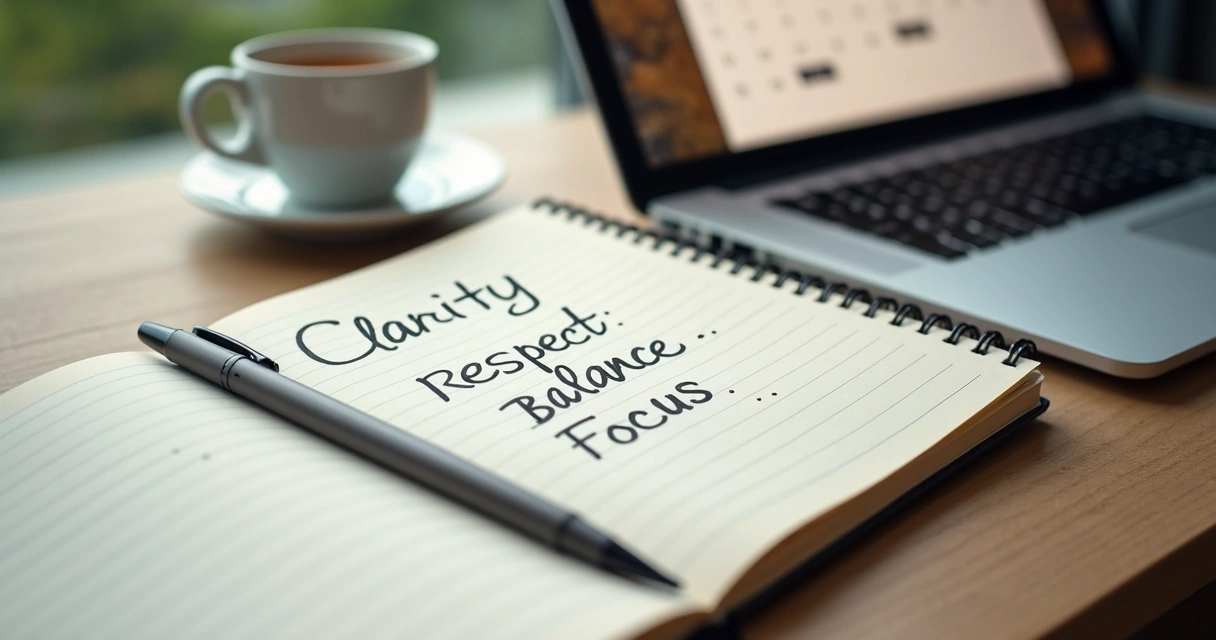
For example, if we value clarity, we may decide to send fewer vague messages and replace them with concise requests. If we value health, we may block a real lunch break and keep it even on home days. If we value fairness, we may avoid making side decisions only with those who happen to be physically present.
Where people lose their center
In our experience, value loss in hybrid work rarely starts with a major event. It begins with small permissions. We say yes when we mean no. We answer late messages to avoid discomfort. We skip pauses. We stop noticing our own state.
This is why inner steadiness matters. Topics like emotional maturity and behavioral science help us understand that values are not sustained by intention alone. They are sustained by repeated patterns, emotional regulation, and self-observation.
A short story comes to mind. We once worked with a manager who said trust was one of her top values. Yet every home day, she sent messages to her team late at night. She was not trying to control anyone. She was anxious and thought fast replies would calm her. Her value was trust. Her habit was pressure. Once she saw the gap, she changed one thing only. She scheduled non-urgent messages for the next morning. The whole tone of the team shifted.
Most value conflicts at work are behavior conflicts before they are belief conflicts.
Practices that help us stay aligned
We do not need dramatic rituals. We need steady ones. A few simple practices can keep our values close in both home and office settings.
Here are five that work well:
Start the day by naming one value you want to embody in action.
Pause before meetings and ask what tone you want to bring.
Keep one non-negotiable boundary around time, attention, or rest.
Review moments of tension and ask which value felt threatened.
Use brief grounding practices to return to presence.
We often see that meditation supports this process because it helps us notice impulses before they become actions. Even one minute of conscious breathing between tasks can interrupt automatic reactions.
And when we study consciousness, we begin to see that awareness itself is a work skill. It helps us perceive when our day is being driven by fear, image, speed, or true conviction.

How leaders can protect values without forcing sameness
Leaders shape the emotional climate of hybrid work. They do this less by speeches and more by patterns. If a leader says balance matters but praises only constant availability, the real message is clear.
Good support for personal values does not mean treating everyone the same way. It means creating fair conditions where people can work in ways that do not violate their core standards.
That can include:
Clear norms about response times and meeting hours.
Equal access to information for remote and in-person staff.
Regular check-ins that include wellbeing, not just tasks.
Space for people to name what helps them do their best work.
When teams have these agreements, values become easier to live. Not perfect. But visible.
Conclusion
Hybrid work asks us to carry our values across changing spaces. That takes more than good intention. It takes attention, honesty, and practice. When we anchor values in habits, language, and limits, we stop relying on mood or circumstance.
We become more coherent. Others feel it too.
In hybrid work, values are what keep freedom from turning into confusion.
Frequently asked questions
What are personal values in hybrid work?
Personal values in hybrid work are the principles that guide how we act across remote and in-person settings. They can include respect, honesty, balance, fairness, presence, or accountability. These values matter when we decide how we communicate, set boundaries, use time, and treat others in different work environments.
How to identify my core values?
We can identify core values by looking at moments of pride, tension, and regret. Pride often shows where we acted in line with our values. Tension shows where a value felt threatened. Regret can reveal where we betrayed our own standards. Writing down repeated themes and narrowing them to three to five clear values is a good start.
Why anchor values in hybrid work?
We anchor values in hybrid work because changing environments can blur our limits and habits. Without a clear inner reference, we may become reactive, inconsistent, or always available. Anchored values help us make stable choices, protect wellbeing, and build trust with others across different settings.
How can leaders support personal values?
Leaders can support personal values by setting fair norms, respecting boundaries, and modeling the behavior they expect from others. They can also make room for honest conversations about work preferences, communication styles, and team agreements. When leaders act with coherence, people feel safer doing the same.
What challenges affect values in hybrid work?
Common challenges include blurred work-life boundaries, pressure to be constantly reachable, unequal treatment between remote and in-person staff, unclear expectations, and emotional fatigue. These conditions can pull us away from our values unless we create habits and limits that protect what matters most.